
 By for01work02@gmail.com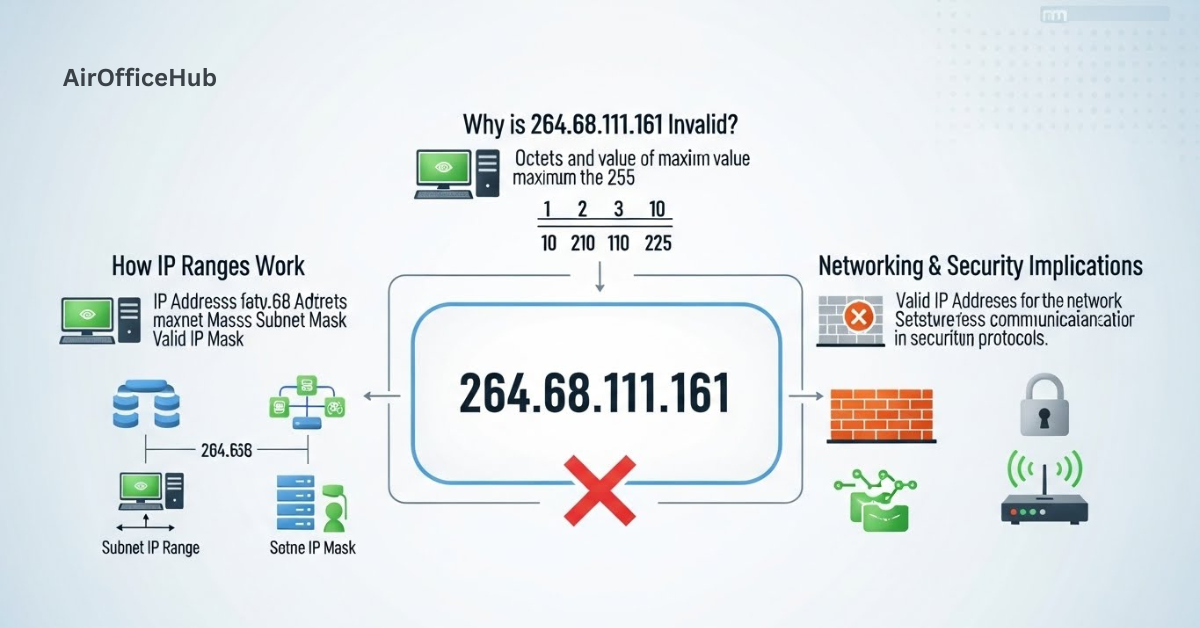
You may see a series of numbers like this: 264.68.111.161 while navigating the web or configuring a network. Although it appears to be nothing more than an IP address at first look, there is actually more going on here than meets the eye. The importance of knowing what makes an IP address legitimate is rising in tandem with the rate of technological development and the extent to which we depend on digital communication.
In order for devices linked to networks to communicate with each other, IP addresses are used as distinct identities. Nevertheless, not all permutations of numbers are valid or applicable in the modern networking world—just like our 264.68.111.161 buddy! Come with us as we go into the reasons why this specific sequence isn’t acceptable and discover how to confidently traverse the world of IP addressing!
What Is 264.68.111.161? Understanding the IP Address
Internet Protocol (IP) addresses, such as 264.68.111.161, are used to identify specific devices on a network.
In networking frameworks, each portion of the address is associated with a certain range of numbers.
The IPv4 standard specifies that this format must have four octets separated by periods.
Having said that, you must be aware that not every IP address is legitimate or applicable in real life.
At first look, an IP address like 264.68.111.161 can seem authentic, but it doesn’t meet the standards for acceptable addresses.
When working with network configurations or troubleshooting connectivity issues, it is helpful to understand these subtleties so that one can avoid typical mistakes.
We can better grasp the seamless transfer of data across networks if we can identify what makes an IP address genuine.
Why 264.68.111.161 Is an Invalid IP
The first octet of the IP address 264.68.111.161 is greater than or equal to 255, rendering it invalid.
Octets, or four groups of numbers, are comprised of an IP address, which is then separated by periods. Since there is a strict range for each octet—from 0 to 255—all legitimate integers must adhere to this range.
When this threshold is crossed, an octet is no longer in accordance with the protocols of the Internet. Consequently, you can expect connectivity problems and errors if you try to utilize or reference that address.
For successful communication between devices on the internet, it is crucial to adhere to defined numerical boundaries in networking protocols, as this mismatch shows.
IP Address Ranges Explained: Why 264.68.111.161 Doesn’t Fit
There are several different ranges of IP addresses, and each one has a distinct function. The IPv4 format, which is the most popular, contains four digits separated by periods. One to two hundred and fifty-five is the possible range for any number.
This leads us to the relevant IP address: 264.68.111.161. Its familiar structure gives it the appearance of validity at first look.
But the problem is in the first byte; 264 is more than the maximum permitted value of 255 for any segment in an IPv4 address. Devices and networks will not be able to identify or route traffic correctly connected with this IP because of this.
Having a grasp of these ranges sheds light on the impossibility of specific addresses in real-world networking situations. For effective communication on both local and global networks, correctly formed IP addresses are crucial.
You May Like: Hothaylost: Digital Trend, Meaning & Why It Matters
Common Errors When Using 264.68.111.161 in Networking
Errors frequently occur when dealing with IP addresses. Assuming 264.68.111.161 can be utilized in networking settings is a common mistake.
Octets are limited to a range of 0 to 255, and this address goes beyond that. When entering settings or resolving connectivity issues, many people could miss this fact.
Mistakes made during configuring can also include typos. More complex access issues may arise from a single typo, particularly in bigger networks involving numerous devices.
Invalid IP addresses like this one might also arise from a failure to comprehend subnetting rules. Users could mistakenly believe they can allocate it locally without understanding its complete invalidity.
Users frequently lose time and energy trying to connect devices seamlessly because they rely on outdated documentation or resources that don’t validate IP ranges.
How to Check If an IP Like 264.68.111.161 Is Valid
Verifying the validity of an IP address, such as 264.68.111.161, is often a simple process.
You should begin by making use of dedicated web resources. Enter the IP address into a website like “ip-checker” or “whois.net” to obtain instantaneous feedback on the IP’s validity.
Manual verification using CIDR notation is another approach. The valid range for an IPv4 address is from 0.0.0.0 to 255.255.255.255, with 0 to 255 numbers allowed in each segment.
The command-line tools ‘ping’ and ‘tracert’ are also at your disposal. Use these instructions to check if the IP can be reached on your network.
You might want to contact your Internet service provider (ISP) or check with your local network administrator. If you ever become confused with IP addresses, they usually provide resources that explain everything.
Conclusion
Having a deep understanding of IP addresses is absolutely crucial in our modern digital era. The 264.68.111.161 story is a great illustration of how people often get IP validity wrong. Avoiding misunderstandings and mistakes in networking is possible when everyone knows that some formats, like this one, aren’t considered standard.
Having knowledge of the correct IP address ranges allows for more efficient management and troubleshooting of networks. You can more easily overcome obstacles if you are well-versed in valid forms.
Staying knowledgeable will assist keep your online activities running well, whether you’ve encountered similar bogus addresses or have further queries about networking techniques. Anyone seeking a deeper grasp of internet connectivity and infrastructure must embark on the adventure through the realm of IPs.
Read More: Kompama Explained — Meaning & Key Insights